

1. Introduction: The Rise of Hyaluronic Acid Body Fillers
Over the past decade, the demand for non-surgical buttock augmentation, hip reshaping, and general body contouring has grown faster than almost any other category within aesthetic medicine. Many patients are seeking subtler, customizable enhancements without undergoing surgical procedures such as lipofilling or implants. This shift has opened the door for body-grade hyaluronic acid fillers, with Hyacorp® becoming one of the most consistently selected products among medical practitioners.
Unlike facial fillers adapted for off-label body use, Hyacorp was engineered specifically for deeper tissue planes, mechanical resistance, increased cohesivity, and the unique dynamic requirements of gluteal areas. Its structure provides controlled projection, smooth shaping, and a predictable longevity profile.
This article serves as a practical, technical guide for professionals who want to apply the Hyacorp body filler protocol safely and effectively, using Hyacorp MLF1 and MLF2 for gluteal augmentation and hip dip correction. The protocol presented here is based on clinical best practices, anatomical considerations, and the safety recommendations widely shared among specialist physicians.
2. Understanding Hyacorp®: What Makes It a Body-Specific Filler
Hyacorp® is a hyaluronic acid filler produced by BioScience GmbH, a German manufacturer known for its CE-certified products intended for body contouring applications. The Hyacorp line consists of different formulations, with MLF1 and MLF2 being the two most commonly used for body shaping procedures.
2.1 Composition and Characteristics
Hyacorp consists of hyaluronic acid that has undergone a specific cross-linking process designed to withstand higher mechanical forces. Compared to facial fillers, Hyacorp features:
- Higher cohesivity
- A stronger degree of cross-linking
- Greater lifting capacity
- Long-term shape retention
- A slow and predictable biodegradation pattern
These properties allow the filler to behave like a supportive scaffold in areas where tissue mobility is high—such as the gluteal region—while maintaining a natural look and feel.
3. MLF1 vs. MLF2: How to Choose the Right Product
Although both fillers belong to the Hyacorp body line, MLF1 and MLF2 serve different purposes. Choosing the correct one is essential for safe and harmonious results.
3.1 Hyacorp MLF1
MLF1 is formulated for areas requiring fine contouring or volume smoothing rather than aggressive projection. It is typically chosen when the goal is to:
- Correct hip dips
- Soften asymmetries
- Smooth irregularities after liposuction
- Add subtle shaping to the lateral buttock
- Work with patients who have thinner skin
MLF1 sits well in superficial to mid-subcutaneous planes, offering a smooth, natural finish.
3.2 Hyacorp MLF2
MLF2 is the product of choice for greater projection and volumization. It is intended for patients who:
- Want a rounder, lifted, or fuller buttock shape
- Have a flat or “V-shaped” gluteal structure
- Need volume enhancement rather than contour smoothing
- Present a thicker subcutaneous layer
MLF2 has a higher cohesivity and density, making it ideal for deeper planes and volume stacking.
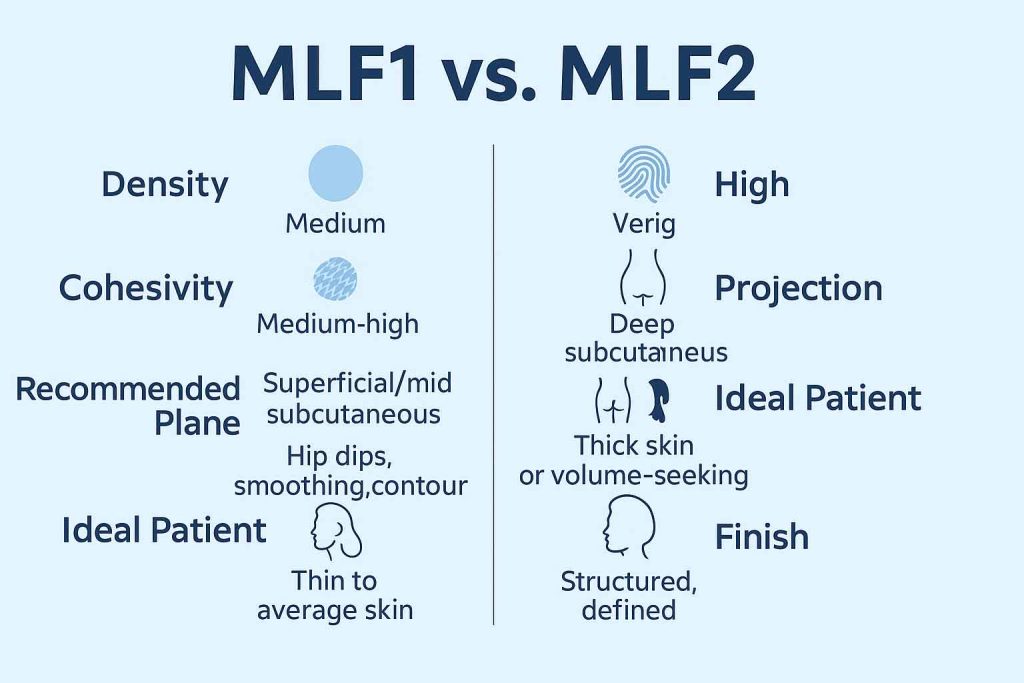
3.3 Comparison Table: MLF1 vs. MLF2
| Feature | Hyacorp MLF1 | Hyacorp MLF2 |
|---|---|---|
| Density | Medium | High |
| Cohesivity | Medium-high | Very high |
| Recommended Plane | Superficial/mid subcutaneous | Deep subcutaneous |
| Typical Use | Hip dips, smoothing, contour | Projection, volumization |
| Ideal Patient | Thin to average skin | Thick skin or volume-seeking |
| Finish | Natural, blended | Structured, defined |
4. Anatomy and Safety: The Foundation of Every Body Filler Procedure
Body fillers must always be placed with anatomical precision. The gluteal region contains significant vascular structures, including the superior and inferior gluteal arteries, branches of the internal iliac system. These vessels run deep beneath the gluteus maximus muscle, which is why deep intramuscular injection must be avoided.
4.1 Safe Injection Plane
The recommended plane for Hyacorp injections is:
The subcutaneous fat layer
NOT the muscle
NOT the subfascial plane**
The subcutaneous layer allows filler spread while minimizing the risk of vascular penetration.
4.2 Why Cannulas Are Preferred
Most professionals strongly recommend using a blunt cannula, typically 18G or 19G, because it:
- Reduces vascular injury
- Allows controlled product deposition
- Minimizes trauma
- Can glide safely inside the subcutaneous plane
The cannula technique also reduces the likelihood of filler embolization.
5. Pre-Procedure: Consultation and Patient Selection
Ideal Candidates
- Individuals seeking non-surgical gluteal enhancement
- Patients with hip dips or lower lateral depressions
- Patients with gluteal asymmetry
- Those who prefer mild to moderate volume increases
Contraindications
- Pregnancy and breastfeeding
- Autoimmune or inflammatory diseases
- Active infections or compromised skin integrity
- Unrealistic expectations
- Desire for extreme-volume augmentation (should be surgical)
Informed Consent Topics
- Volume limits
- Longevity (12–24 months)
- Possibility of touch-ups
- Expected swelling and tenderness
- Risks: infection, vascular complications, nodules, migration
6. Full Professional Injection Protocol for Hyacorp Body Filler
Below is a step-by-step protocol typically followed by medical professionals trained in advanced body sculpting.
6.1 Equipment Checklist
- Hyacorp MLF1 or MLF2 syringes
- 18G or 19G blunt cannulas
- 21G needle (for entry points)
- Antiseptic solution (chlorhexidine preferred)
- Sterile gloves and drapes
- Local anesthetic for entry point
- Cannula introducer
- Skin marker
- Cool compress
- Emergency kit (as standard for aesthetic procedures)
6.2 Mapping the Treatment Area
Clear markings help define:
- Zones requiring projection
- Depressions requiring filling
- Boundaries of safe tissue planes
- Entry points
- Direction of cannula tunnels
For the glutes, it is common to mark upper poles, lateral aspects, and central projection vectors.
For hip dips, the depression follows the trochanteric region; mapping ensures balanced correction.
6.3 Injection Technique (Cannula Method)
This is the safest and most widely adopted approach for Hyacorp body fillers.
Step 1 – Skin Preparation
Cleanse with antiseptic and ensure the entire field remains sterile.
Step 2 – Entry Point
Create a small opening with a 21G needle.
Step 3 – Cannula Introduction
Insert the blunt cannula slowly, ensuring:
- No resistance
- Smooth gliding
- No intramuscular deviation
Step 4 – Product Delivery
Hyacorp should be deposited using:
✔ Retrograde linear threading
✔ Fanning technique
✔ Controlled pressure
✔ Slow injection speed
Avoid bolus injections.
Step 5 – Smoothing
Mild molding may be performed, but vigorous massage should be avoided to prevent product displacement.
7. Recommended Volumes for Each Area
These are average guidelines often referenced by professionals. Final amounts depend on the patient’s anatomy, skin thickness, and aesthetic goals.
Gluteal Volumization (MLF2)
- 20–60 ml per side
- Total: 40–120 ml
Hip Dip Correction (MLF1)
- 5–15 ml per side
- Total: 10–30 ml
Gluteal Contouring or Shape Definition
- MLF1 for smoothing
- MLF2 for projection
- Total: 20–40 ml
8. Specific Techniques for Each Area
8.1 Gluteal Projection Technique (with MLF2)
Use deep subcutaneous planes and linear threads aimed at:
- Increasing projection in the upper and mid-buttock
- Correcting “flat” or “V-shaped” buttocks
- Enhancing curvature of the posterior silhouette
Recommended vectors include:
- Vertical (for upper lift)
- Oblique (for shaping outer projection)
- Horizontal (for widening effect)
8.2 Hip Dip Correction (with MLF1)
Hip dips are treated superficially to mid-subcutaneously:
- Deposit product in lateral depressions
- Use short, delicate retrograde threads
- Aim to connect the upper and lower curves smoothly
MLF1 provides a soft fill ideal for subtle contour blending.
9. Duration of Results and Maintenance Plan
Hyacorp’s longevity varies based on factors like metabolism, lifestyle, physical activity, and the volume initially injected. The typical duration ranges from:
12 to 24 months
For long-term maintenance:
- Touch-ups at 6–9 months
- Volume reinforcement at 12–18 months
Maintaining results often requires less filler than the initial treatment.
10. Possible Complications and Management
Common, Mild Reactions
- Swelling
- Soreness
- Bruising
- Temporary firmness
These typically resolve within 3–10 days.
Less Common but Important Risks
- Infection
- Localized nodules
- Vascular compromise (rare but serious)
- Product migration
- Asymmetry
Prevention Through Technique
- Always use blunt cannulas
- Avoid deep muscle penetration
- Inject slowly
- Do not use sharp needles for product deposition
- Stay within the subcutaneous fat layer
11. MLF1 vs. MLF2: Final Quick-Reference Guide
| Objective | Best Choice | Why |
|---|---|---|
| Hip dip correction | MLF1 | Soft contouring, natural finish |
| Gluteal projection | MLF2 | High density and lift |
| Smoothing irregularities | MLF1 | Medium consistency, blends well |
| Sculpted, rounded shape | MLF2 | Strong cohesivity |
| Thin skin | MLF1 | Safer and more adaptable |
| Thick tissue | MLF2 | Suitable for deep volumization |
12. Conclusion: A Safe, Modern Alternative for Non-Surgical Body Shaping
Hyacorp MLF1 and MLF2 fillers offer medical professionals an effective and customizable tool for shaping glutes and hips without surgery. When combined with anatomical knowledge, proper patient selection, and a structured injection protocol, these fillers provide natural, long-lasting enhancements with a predictable safety profile.
For patients unwilling or unable to undergo fat grafting, Hyacorp presents a compelling alternative with minimal downtime and a high satisfaction rate.
13. Sources of Information
This article is based on publicly accessible professional information from BioScience GmbH, the manufacturer of Hyacorp, including their official product descriptions and clinical guidelines available at:
Additional insights come from international aesthetic medicine literature and clinical best practices frequently referenced by physicians performing body HA injections.