

Thread lifting has become one of the most valuable tools in modern aesthetic medicine for patients seeking skin tightening and contour definition without the downtime of surgery. Over the past decade, different thread technologies have entered the market, each promising better lift, improved collagen stimulation, and more predictable results.
Among the most commonly compared systems —especially in searches related to Silhouette Soft vs PDO threads— two have clearly established themselves as benchmarks:
- PDO (polydioxanone) barbed threads, widely used for mild lifting and skin quality improvement.
- PLLA (poly-L-lactic acid) threads with bidirectional cones, best known through the Silhouette Soft platform.
Despite sharing similar goals, their materials, mechanisms, anchoring principles, longevity, and clinical outcomes differ significantly. Understanding these distinctions is essential for any aesthetic practitioner seeking to achieve predictable and reproducible results.
This guide offers a technical yet practical comparison aimed at professionals searching for reliable information on “Silhouette Soft vs PDO threads”, “PLLA vs PDO”, and advanced thread lifting techniques.
1. Understanding Each System: Materials and Core Function
1.1 What PDO Threads Are and How They Work
PDO (polydioxanone) is a synthetic, absorbable polymer long used in suturing. In aesthetics, PDO threads come in several formats—smooth, twisted, and, most importantly, barbed or “cog” threads, which provide mild lifting by engaging the tissue mechanically.
(Source: Clique Clinic – Silhouette Soft vs PDO Threads; Ashbrooke Cosmetic Surgery – PDO Thread Lifts vs Silhouette)
Their primary actions are:
- Mechanical support through the barbs that catch onto subcutaneous tissue.
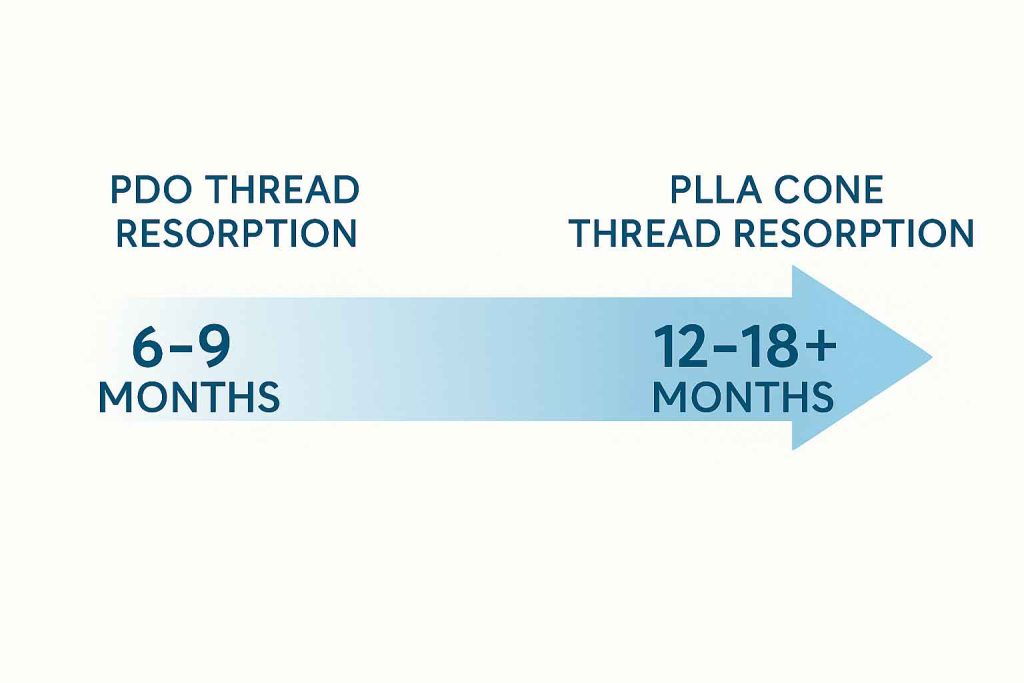
- Biostimulation as the PDO degrades, promoting collagen production over 6–9 months.
- Improvement in skin texture and mild tightening rather than dramatic lifting.
PDO threads are absorbed relatively quickly compared with PLLA, making them well suited for patients with early or mild laxity or those seeking subtle refinement.
1.2 What PLLA Threads With Bidirectional Cones (Silhouette Soft) Offer
Silhouette Soft uses PLLA/PLGA threads combined with bidirectional cones strategically placed along the thread to anchor deeply into the tissue.
(Source: Dr. Paloma Clinic – Sutures Silhouette Soft)
This design allows for two simultaneous actions:
- A strong and immediate mechanical lifting effect thanks to the cones’ grip on the tissue.
- Long-term collagen stimulation as PLLA breaks down, improving firmness and facial contour over time.
(Source: FacePlus Plastic Surgery – PDO vs PLLA Threads)
PLLA degrades more slowly than PDO, giving it a longer duration of effect—commonly 12–18 months, and in some clinical experiences, up to 24 months.
The combination of cones + PLLA makes Silhouette Soft a true lifting thread, not just a skin-tightening tool.
2. Anchoring Capacity: Why Silhouette Soft Provides Stronger Support
Below is a technical comparison of how each type of thread achieves anchoring:
| Feature | PDO Barbed Threads | PLLA Threads With Bidirectional Cones (Silhouette Soft) |
|---|---|---|
| Material | Polydioxanone (PDO) | Poly-L-lactic acid (PLLA) / PLGA |
| Anchoring mechanism | Tissue engagement through barbs | Deep anchoring through cones that distribute force evenly |
| Immediate lift | Mild–moderate | Strong and visible |
| Longevity | ~6–9 months | 12–18+ months |
| Collagen stimulation | Present but limited | Strong, progressive and long-lasting |
| Ideal candidates | Mild laxity, younger patients | Moderate laxity, contour loss, facial sagging |
| Predictability | Good for subtle tightening | Excellent for structural lifting |
2.1 Why Cones Offer Superior Traction
Silhouette Soft’s cones distribute tension across a wider contact surface, making them less prone to slipping compared with barbs.
(Source: PMC – Thread Lifting Techniques and Complications)
The result:
- A more stable lifting vector
- A higher degree of repositioning
- Longer maintenance of the achieved lift
Moreover, the cones provide a dual anchoring system, allowing bidirectional suspension without excessive tension or risk of thread migration.
3. Indications: When to Choose PDO and When to Choose PLLA/Cones
3.1 PDO Thread Indications
PDO threads work best for:
- Mild skin laxity
- Subtle repositioning rather than dramatic lifting
- Younger patients (25–40) with good tissue density
- Skin quality improvement (texture, fine wrinkles)
- Areas requiring delicate manipulation (around the eyes or mid-face superficial layers)
3.2 PLLA/Cones (Silhouette Soft) Indications
Silhouette Soft threads are more appropriate for:
- Moderate skin laxity
- Jawline and lower-face sagging
- Mid-face descent, cheek ptosis, and early jowls
- Patients seeking a non-surgical lifting alternative
- Long-lasting results without fillers
- Those who require structural support rather than superficial tightening
The lift produced by cone-based systems is closer to a surgical vector, although less dramatic.
4. Longevity and Maintenance
- PDO threads: absorb in 6–9 months, with collagen stimulation extending effects slightly beyond that. Maintenance every 6–12 months is common.
- PLLA/Cones: degrade more slowly, offering 12–18+ months of lift.
(Source: FacePlus Plastic Surgery – Which Lasts Longer?)
Patients often need fewer maintenance sessions with PLLA, which reduces long-term cost and clinical workload.
5. Safety Profile and Complications
Both systems share common, manageable post-procedure effects such as swelling, mild bruising, and tenderness.
PDO-Specific Considerations
- Generally lower risk of visibility or palpability
- Ideal for thinner skin
- Easier for beginners due to simpler technique
PLLA/Cones Considerations
Because PLLA threads provide stronger traction:
- Incorrect depth can lead to cone palpability
- Superficial placement increases risk of irregularities or dimpling
(Source: PMC – Clinical Complications in Thread Lifts) - Proper training is mandatory to avoid asymmetry or overcorrection
Silhouette Soft requires precise vector planning, making practitioner experience essential.
6. Evidence and Professional Consensus
Several reviews point to the key differences:
- PLLA threads generally produce longer-lasting and more pronounced lifting compared with PDO.
(Source: FacePlus Plastic Surgery – PDO vs PLLA Threads) - The anchoring strength of bidirectional cones is mechanically superior to barbed PDO designs.
(Source: PMC – Evaluation of Thread Lift Techniques) - Many aesthetic physicians consider Silhouette Soft preferable for jawline contouring and mid-face repositioning, where anchoring strength is critical.
(Source: Dr. Paloma – Silhouette Soft Sutures)
7. Final Verdict: Which System Offers Better Anchoring?
For subtle lifting and skin tightening:
PDO barbed threads remain a reliable, cost-effective option, especially for younger patients or those seeking conservative enhancement.
For structural lifting and contour definition:
Silhouette Soft (PLLA with bidirectional cones) offers superior anchoring, a more defined lifting vector, and longer-lasting results. This makes it ideal for facial ptosis, jawline blurring, and mid-face descent.
The best practice for clinics:
Mastering both techniques allows practitioners to treat a wider range of patients and indications, offering tailored, predictable outcomes.
8. Professional Recommendations
- Invest in specialized training for PLLA/cone placement—incorrect depth is the main source of complications.
- Always select patients carefully: excessive skin redundancy may require surgery, not threads.
- Combine threads with other technologies (bio-stimulators, RF, ultrasound) for synergistic results.
- Document vectors, insertion points, and patient anatomy to maintain consistency across sessions.
9. References and External Professional Sources
All links lead to professional clinics, medical publications, or educational pages—never to commercial shops or product sales pages:
- Clique Clinic – Silhouette Soft vs PDO Threads:
https://www.cliqueclinic.com/es/blog/silhouette-soft-vs-pdo - FacePlus Plastic Surgery – PDO vs PLLA Threads:
https://faceplusplasticsurgery.com/articles/pdo-threads-vs-plla-threads-which-lasts-longer-and-looks-more-natural - Ashbrooke Cosmetic Surgery – PDO Thread Lifts vs Silhouette Thread Lifts:
https://ashbrookesh.com.au/pdo-thread-lifts-vs-silhouette-thread-lifts - Dr. Paloma – Silhouette Soft Sutures:
https://drpaloma.com/hilos-tensores-suturas-silhouette - PMC – Complications in Thread Lifts:
https://pmc.ncbi.nlm.nih.gov/articles/PMC11086642 - Kalos Clinic – In-Depth Thread Lift Review:
https://kalosestetica.es/hilos-tensores-un-estudio-en-profundidad