

Dilution ratios, treatment areas, and skin quality protocols for calcium hydroxylapatite biostimulation
The demand for skin quality improvement without structural volume has significantly increased in modern aesthetic medicine. In this context, hyperdiluted Radiesse has become a key tool for collagen biostimulation, skin tightening, and dermal quality enhancement without altering facial anatomy.
Unlike traditional structural use of calcium hydroxylapatite (CaHA), hyperdiluted Radiesse is designed to improve skin firmness, elasticity, and texture, making it especially suitable for areas where volume is not desired.
This article provides a complete clinical guide to Radiesse hyperdilution, including dilution ratios, indications, protocols, and patient selection, specifically for aesthetic medicine professionals.
What Is Hyperdiluted Radiesse?
Hyperdiluted Radiesse refers to the dilution of CaHA with saline solution and/or local anesthetic to reduce its volumizing effect while maximizing its biostimulatory properties.
When used in this manner:
- Structural projection is minimized
- Product distribution becomes more homogeneous
- Fibroblast activation is enhanced
- Neocollagenesis is stimulated over time
The primary goal is skin quality improvement, not contouring or volumization.
Mechanism of Action of CaHA in Dilution
When Radiesse is hyperdiluted:
- The gel carrier acts as a delivery vehicle
- CaHA microspheres stimulate fibroblasts
- Collagen types I and III production increases
- Dermal thickness and elasticity improve progressively
This approach is particularly effective in areas with thin skin or early laxity, where volumizing fillers are contraindicated.
Structural Radiesse vs Hyperdiluted Radiesse
| Feature | Structural Radiesse | Hyperdiluted Radiesse |
|---|---|---|
| Primary objective | Support and projection | Skin quality improvement |
| Immediate volume effect | High | Minimal or none |
| Injection plane | Deep structural planes | Superficial subdermal |
| Distribution | Localized | Diffuse |
| Ideal patient | Structural volume loss | Mild to moderate skin laxity |
Radiesse Dilution Ratios and Clinical Indications
Choosing the correct dilution depends on:
- Treatment area
- Skin thickness
- Degree of laxity
- Desired level of stimulation
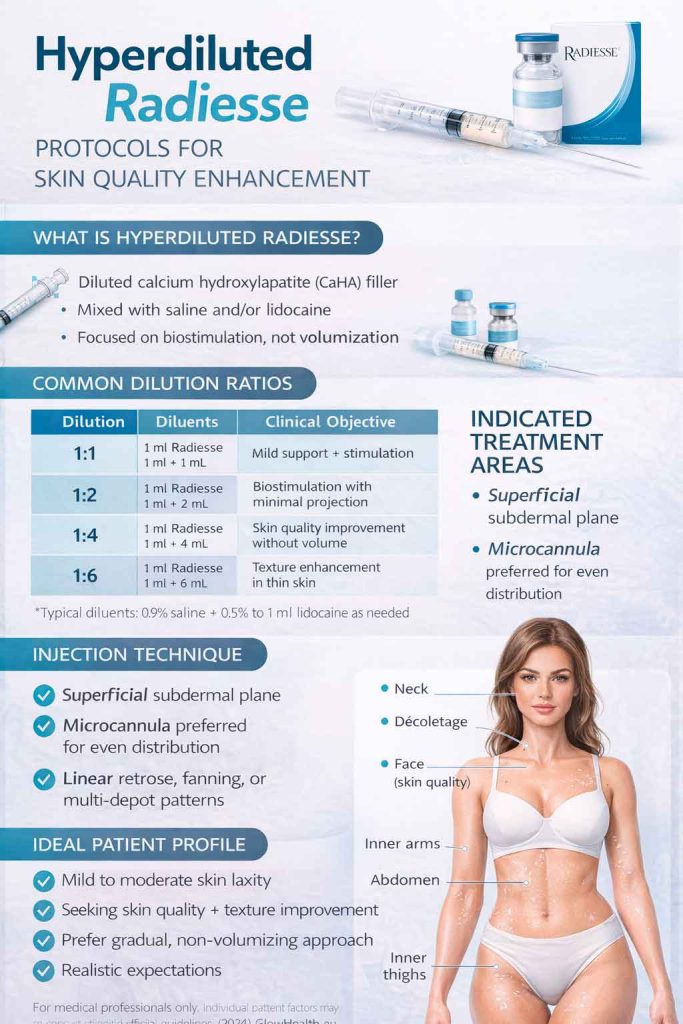
Commonly Used Dilutions
| Dilution Ratio | Typical Preparation | Clinical Objective |
|---|---|---|
| 1:1 | 1 ml Radiesse + 1 ml diluent | Mild support + stimulation |
| 1:2 | 1 ml Radiesse + 2 ml diluent | Biostimulation with minimal projection |
| 1:4 | 1 ml Radiesse + 4 ml diluent | Skin quality improvement without volume |
| 1:6 | 1 ml Radiesse + 6 ml diluent | Superficial laxity and texture enhancement |
Diluent usually consists of saline solution, optionally combined with lidocaine according to physician preference.
Indicated Treatment Areas
Hyperdiluted Radiesse is especially effective in areas requiring firmness and dermal stimulation rather than volume:
- Neck
- Décolletage
- Inner arms
- Inner thighs
- Abdomen
- Global facial skin quality improvement
These zones share a common need for collagen stimulation without contour modification.
Recommended Injection Approach
While techniques may vary by practitioner and anatomical area, general principles include:
- Superficial subdermal plane
- Linear retrograde or fanning technique
- Preference for microcannula to ensure even distribution
- Low volume per pass
- Gentle post-treatment massage
Hyperdiluted Radiesse is not a precision volumetric treatment but a diffuse biostimulatory approach.
Number of Sessions and Maintenance
- Initial protocol: 1–2 sessions
- Interval: 4–6 weeks
- Maintenance: Annually or based on clinical response
Visible improvement typically begins between weeks 4 and 6, with continued enhancement over several months.
Common Mistakes in Hyperdiluted Radiesse Treatments
- Using insufficient dilution in thin skin areas
- Injecting too deeply, reducing dermal stimulation
- Expecting immediate lifting effects
- Treating severe laxity (not indicated)
- Poor product distribution
Appropriate patient selection is essential to achieve optimal outcomes.
Ideal Patient Profile
Hyperdiluted Radiesse is best suited for patients who:
- Present mild to moderate skin laxity
- Seek skin firmness and texture improvement
- Do not want volumetric changes
- Accept gradual, progressive results
- Have realistic expectations
It is not intended to replace structural fillers in cases of significant volume loss.
Conclusion
Hyperdiluted Radiesse represents a refined approach to biostimulation focused on skin quality rather than volume. When properly diluted and correctly indicated, it offers predictable, natural, and progressive results across multiple anatomical areas.
For aesthetic medicine professionals, mastering dilution strategies and protocols significantly expands treatment possibilities for patients seeking subtle, high-quality outcomes.
Official References
- Merz Aesthetics – Radiesse
https://merz.com/aesthetics/radiesse/ - Merz Aesthetics – CaHA Science
https://merz.com/aesthetics/science/ - Radiesse Official Website
https://www.radiesse.com/