

Sculptra® (poly-L-lactic acid, PLLA) has become one of the most advanced tools in modern aesthetic medicine for collagen biostimulation. Unlike hyaluronic acid dermal fillers, which restore volume immediately, Sculptra works gradually. It stimulates fibroblasts to produce new collagen, resulting in progressive and long-lasting improvements in skin firmness, elasticity, and volume—often lasting more than two years.
However, despite its safety and efficacy, Sculptra requires precise injection technique, careful preparation, and structured clinical follow-up. Among potential complications, nodules are one of the most frequently discussed issues in clinical practice. Although their incidence has decreased significantly due to improved protocols, nodules remain a concern for patients and physicians alike, making Sculptra nodules treatment a key topic for aesthetic professionals.
This article provides a comprehensive, evidence-based guide for aesthetic practitioners on Sculptra nodules treatment—covering prevention, management, patient communication, and clinical best practices.
What Are Nodules After Sculptra?
Nodules are palpable or visible lumps that may appear in areas treated with Sculptra. They can range from small, asymptomatic irregularities to more noticeable or inflammatory lesions that require medical intervention.
They form when PLLA microparticles aggregate instead of dispersing evenly, or when the local tissue response is exaggerated.
Clinical Classification
| Type of Nodule | Description | Onset | Clinical Approach |
|---|---|---|---|
| Palpable, not visible | Detected by touch, no cosmetic concern | Weeks to months | Observation, massage |
| Visible | Noticeable lumps altering surface contour | 2–6 months | Intralesional corticosteroids |
| Inflammatory | Painful, red, tender | Rare | Corticosteroids + antibiotics |
| Persistent | Fail to resolve with conservative care | >6 months | Aspiration or surgical excision |
Incidence and Risk Factors
In early clinical use, Sculptra had higher reported nodule rates. Today, thanks to better dilution protocols and injection techniques, incidence has dropped to below 5%.
Risk Factors for Nodule Formation
- Inadequate dilution: too concentrated solutions lead to clumping.
- Poor reconstitution: short hydration time prevents uniform dispersion.
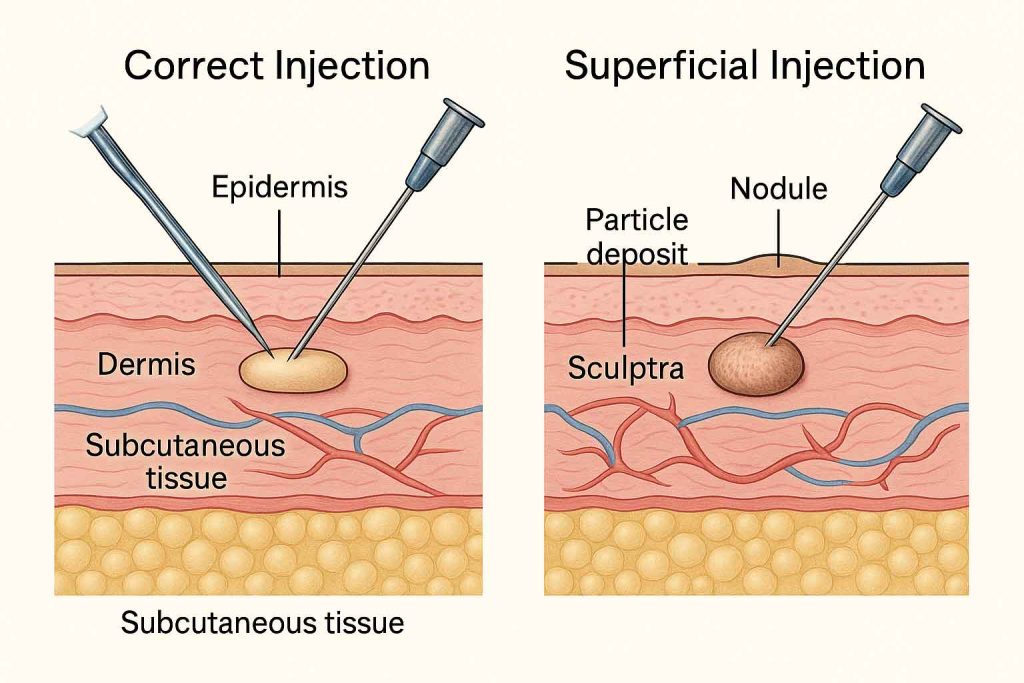
- Incorrect injection depth: superficial or bolus injections increase risk.
- Large volume in a single area: causes uneven distribution.
- Lack of post-injection massage: particles remain aggregated.
- Patient factors: inflammatory predisposition, poor compliance with aftercare.
Prevention: The Cornerstone of Sculptra Practice
Prevention is the best strategy. Most nodules can be avoided with proper preparation, correct technique, and patient education.
Reconstitution and Dilution
- Dilute each vial with 8–10 ml sterile water or saline, optionally with lidocaine.
- Allow 12–24 hours for full hydration before injection.
- Shake gently before use to ensure homogeneous suspension.
Injection Technique
- Use retrograde or fanning techniques with a cannula or fine needle.
- Avoid bolus injections and superficial placement in the dermis.
- Distribute product across multiple planes and sessions instead of a single large volume.
Massage Protocol
The 5x5x5 rule is widely adopted:
- 5 minutes,
- 5 times a day,
- for 5 consecutive days.
This disperses PLLA microparticles and reduces the chance of aggregation and nodule formation.
Treatment of Sculptra Nodules
When nodules appear, the approach depends on type and severity.
Clinical Management Strategies
| Nodule Type | Recommended Treatment | Response Time |
|---|---|---|
| Palpable, not visible | Massage and observation | 2–6 months |
| Visible, non-inflammatory | Intralesional corticosteroids (e.g., triamcinolone) | 2–8 weeks |
| Inflammatory | Oral antibiotics (doxycycline, clarithromycin) + corticosteroids | 2–4 weeks |
| Persistent or esthetic concern | Aspiration, laser therapy, or surgical excision | Variable |
Practical Algorithm for Clinics
- Evaluate carefully: confirm it is a nodule, not infection or granuloma.
- Classify: palpable, visible, inflammatory, or persistent.
- Conservative approach first: massage and monitor in mild cases.
- If unresolved >6–8 weeks or cosmetically concerning: intralesional corticosteroids.
- If inflammatory: add antibiotics.
- Persistent or resistant cases: refer for surgical or dermatological intervention.
Patient Education: A Key to Prevention
Educating patients is essential for both clinical outcomes and patient confidence.
What Patients Should Know
- Massage is mandatory: compliance is critical to prevent nodules.
- Small palpable nodules may occur and often resolve spontaneously.
- Visible or painful nodules require immediate follow-up.
- Scheduled clinic visits at 2 and 4 weeks post-treatment are necessary.
By setting clear expectations, clinics reduce patient anxiety and avoid unnecessary alarm.
Frequently Asked Questions
What is the current incidence of Sculptra nodules?
With modern protocols, the rate is <5%.
Do nodules always need treatment?
Not always. Many palpable nodules resolve spontaneously, but visible or inflammatory ones should be treated.
Can patients who developed nodules receive Sculptra again?
Yes, once nodules resolve. Technique, dilution, and massage should be optimized.
What is the difference between a benign nodule and a granuloma?
- Nodules: localized, usually non-inflammatory, respond to massage or corticosteroids.
- Granulomas: true immune response, larger, more resistant, require specialized care.
Evidence and Literature
- Early studies reported nodule rates as high as 20%.
- With extended hydration, larger dilutions, and massage protocols, incidence fell to <5%.
- Most nodules are benign and manageable with conservative measures.
Best Practices for Clinics
- Standardize dilution and reconstitution protocols.
- Document injection technique, product volume, and treated areas.
- Provide written massage instructions for patients.
- Schedule mandatory 2- and 4-week follow-ups.
- Keep steroids and antibiotics on hand for early intervention.
Visual Educational Tools
To reinforce learning and communication:
- Cross-sectional diagram: show correct vs incorrect injection depth.
- Infographic: summarize prevention steps (dilution, massage, technique).
- Table graphic: nodule types and treatments.
- Clinic photo: doctor explaining aftercare to patient.
These visuals help patients understand aftercare and support professional training.
Clinical Takeaways
Sculptra is one of the most effective tools for long-term collagen stimulation and natural rejuvenation. While nodules are a known complication, their incidence is low when modern techniques are applied.
The pillars of success in Sculptra nodules treatment are:
- Prevention: correct dilution, careful injection, and patient massage compliance.
- Tailored management: treatment depends on the nodule’s type and severity.
- Patient communication: ensures adherence, reduces anxiety, and builds trust.
By following structured protocols, clinics can deliver safe, predictable, and satisfying results, strengthening their professional reputation and patient loyalty.
Recommended Source
Looking for reliable access to Sculptra® and other trusted aesthetic products? At GlowHealth, we provide clinics and doctors with on-demand supplies, delivered within 24–48 hours.
Explore Aesthetic Medicine Products On Demand at GlowHealth
Shop Sculptra online with fast 24–48h delivery
On-Demand Aesthetic Medicine Products
At GlowHealth, we provide a fast and reliable aesthetic medicine supply service, delivering directly to your clinic within 24–48 hours. We work only with leading international brands, ensuring safety, quality, and trust for every professional.