

Teosyal RHA 4 vs Restylane Defyne is a comparison that reflects how aesthetic medicine has evolved over the past decade. The focus has shifted from simply restoring volume to achieving natural, dynamic, and expression-preserving results, especially in high-mobility facial areas where stiffness and unnatural movement remain key clinical challenges.
Patients are no longer only concerned about longevity; they increasingly ask whether the filler will be visible when they smile or speak. This shift in expectations has driven the development of dynamic hyaluronic acid fillers, specifically engineered to adapt to facial movement.
Both products are designed for dynamic facial zones, yet they rely on distinct rheological technologies: Resilient Hyaluronic Acid (RHA) and Optimal Balance Technology (OBT™). Understanding these differences is essential for informed clinical decision-making.
Understanding rheology in dermal fillers
Rheology is the study of how materials deform and flow under applied forces. In dermal fillers, rheology determines how a product behaves both at rest and during facial movement.
From a clinical standpoint, rheology helps answer critical questions:
- How does the filler respond to repeated facial expressions?
- Does it recover its shape after deformation?
- Does it provide support without rigidity?
- How well does it integrate into moving tissues?
Key rheological parameters in aesthetic medicine
Several rheological parameters are relevant, but the most clinically significant include:
- G’ (elastic modulus): the filler’s ability to resist deformation and maintain shape.
- Elasticity and resilience: the capacity to stretch and return to its original structure.
- Cohesivity: internal bonding of the gel, influencing stability and tissue integration.
- Dynamic adaptability: performance under continuous mechanical stress.
In high-mobility areas, excessive stiffness can lead to unnatural results, while insufficient support may compromise durability.
High-mobility facial areas: specific clinical demands
High-mobility or dynamic facial zones include:
- Nasolabial folds
- Marionette lines
- Oral commissures
- Perioral region
- Chin in expressive patients
These areas are subjected to constant and repetitive mechanical forces. An inadequately selected filler may result in:
- Visible stiffness during expression
- Dynamic creasing or irregularities
- Palpable product sensation
- Uneven degradation over time
Therefore, fillers intended for these regions must be capable of moving with the tissue rather than opposing it.
Teosyal RHA 4: Resilient Hyaluronic Acid designed for facial expression
The RHA concept: mimicking native hyaluronic acid
The Teosyal RHA range was developed by TEOXANE to closely replicate the properties of natural hyaluronic acid found in the skin. Unlike traditional fillers with high crosslinking density, RHA technology preserves long HA chains, allowing greater flexibility and resilience.
Official source:
https://www.teoxane.com/en/rha-collection/
Rheological profile of Teosyal RHA 4
Teosyal RHA 4 is the most supportive product in the RHA range while maintaining dynamic adaptability.
Key characteristics:
- High dynamic elasticity
- Excellent stretchability
- Strong resilience under repeated movement
- Smooth tissue integration
Rheologically, RHA 4 deforms easily during facial expression and quickly recovers its structure at rest, reducing the risk of visible stiffness.
Clinical implications
Teosyal RHA 4 is particularly suitable for:
- Highly expressive patients
- Mild to moderate dynamic folds
- Areas where natural movement is prioritized over strong projection
Clinicians often describe it as a filler that becomes “invisible in motion.”
Restylane Defyne: structural support with flexibility using OBT™
Optimal Balance Technology explained
Restylane Defyne, developed by Galderma, is part of the XpresHAn Technology™ portfolio. OBT™ (Optimal Balance Technology) is designed to balance flexibility with structural integrity.
Official source:
https://www.galderma.com/us/en/products/restylane-defyne
Rheological profile of Restylane Defyne
Restylane Defyne exhibits a higher G’ value than Teosyal RHA 4, providing increased resistance to deformation while maintaining dynamic capability.
Key characteristics:
- Cohesive gel structure
- Strong resistance to mechanical stress
- Stable projection during movement
- Controlled dynamic behavior
Clinical implications
Restylane Defyne is well suited for:
- Deep nasolabial folds
- Pronounced marionette lines
- Chin support and contouring
- Patients with tissue laxity requiring structure
Its performance is defined by controlled movement and reliable support.
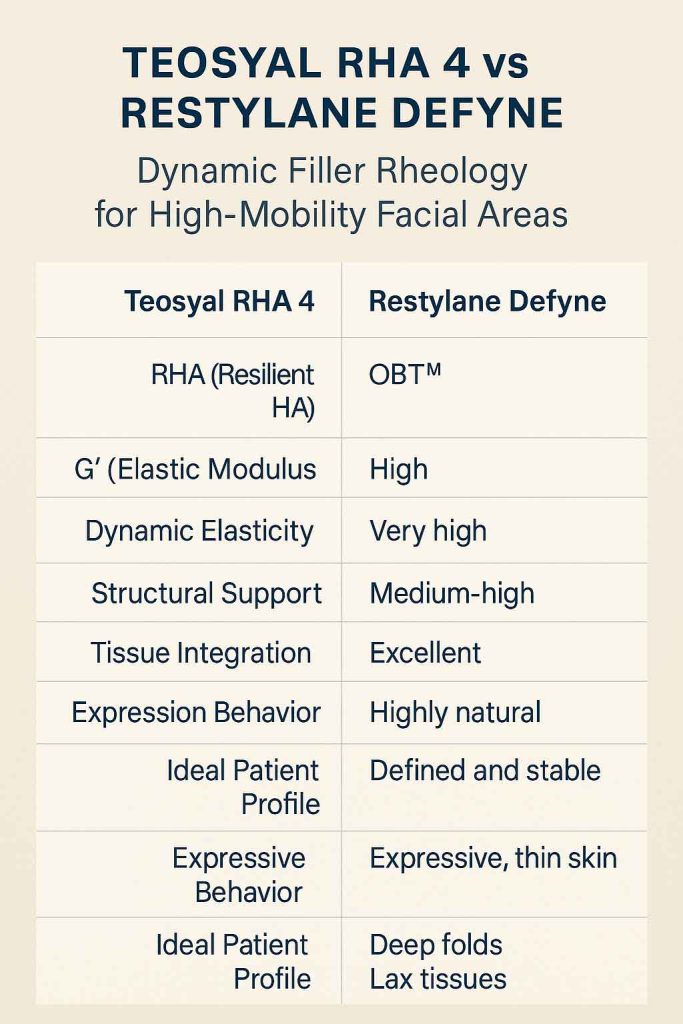
Teosyal RHA 4 vs Restylane Defyne: applied rheological comparison
| Parameter | Teosyal RHA 4 | Restylane Defyne |
|---|---|---|
| Technology | RHA (Resilient HA) | OBT™ |
| G’ (elastic modulus) | Medium-high | High |
| Dynamic elasticity | Very high | High |
| Structural support | Medium-high | High |
| Tissue integration | Excellent | Very good |
| Expression behavior | Highly natural | Defined and stable |
| Ideal patient profile | Expressive, thin skin | Deep folds, lax tissues |
Scientific evidence and biomechanical approach
Both manufacturers emphasize the importance of evaluating fillers under dynamic mechanical conditions, simulating real facial movement rather than static compression alone.
TEOXANE has published data highlighting the resilience of RHA fillers under repetitive stretching forces:
https://www.teoxane.com/science/
Galderma has conducted extensive biomechanical studies on XpresHAn Technology™, focusing on flexibility and support during facial expression:
https://www.galderma.com/science-and-innovation
These approaches reinforce the clinical relevance of dynamic rheology in modern aesthetic practice.
Choosing the right filler for dynamic facial zones
The decision between Teosyal RHA 4 vs Restylane Defyne should be based on individual patient assessment rather than brand preference.
Key factors include:
- Patient age and skin quality
- Degree of facial expressiveness
- Depth of folds
- Structural support requirements
- Patient expectations regarding natural movement
Teosyal RHA 4 is preferred when movement predominates, while Restylane Defyne is advantageous when structural reinforcement is essential. In advanced protocols, both products may be used complementarily.
Impact on patient satisfaction and treatment longevity
Proper rheological selection leads to:
- Fewer touch-ups
- Higher patient satisfaction
- Improved perception of natural results
- Stronger physician-patient trust
Patients consistently value how they look in motion more than how they appear at rest.
Conclusion: rheology as a clinical decision-making tool
The comparison of Teosyal RHA 4 vs Restylane Defyne highlights the importance of rheology as a practical, evidence-based tool in aesthetic medicine.
Understanding how fillers behave dynamically allows clinicians to:
- Customize treatments
- Improve outcomes in complex facial zones
- Elevate the scientific standard of their practice
In contemporary aesthetic medicine, movement is not corrected. It is respected.
Official references
- Teoxane – RHA Collection
https://www.teoxane.com/en/rha-collection/ - Teoxane – Scientific Background
https://www.teoxane.com/science/ - Galderma – Restylane Defyne
https://www.galderma.com/us/en/products/restylane-defyne - Galderma – Science & Innovation
https://www.galderma.com/science-and-innovation